Welcome to COINSTATS blog

We are here, share about any information news from coin

Trusted and legit

Daily update, trusted and legit for visitor used

Trial and error

Before we share all information, we have try it before

Real proof and payment

Before we share information, we must got any payment from other project.

Contact US

We are available 7x24 Hours a week.

Showing posts with label Cryptonews. Show all posts

Bitcoin Developer Publishes Two Proposals for a Taproot Soft Fork


Bitcoin (BTC) developer Pieter Wuille has unveiled two proposals on GitHub for a Taproot soft fork in a message to the bitcoin-dev mailing list on May 6. Taproot is a solution that aims to combine the advantages of Merkelized Abstract Syntax Tree (MAST) and the Schnorr signature scheme in order to reveal less information after a bitcoin transaction takes place.

MAST allows for the alternative possibilities of how a bitcoin transaction could have occurred to remain private, and Schnorr allows for a MAST-enabled transaction to occur without revealing that MAST was used to check transaction conditions. In Wuille’s memo, he notes that the following points are addressed in the proposals: “Taproot to make all outputs and cooperative spends indistinguishable from each other.

Merkle branches to hide the unexecuted branches in script2s. Schnorr signatures enable wallet software to use key aggregation/thresholds within one input.” As Cointelegraph has previously covered, privacy is a feature of bitcoin that is expected but in actuality does not exist to a high degree. Bitcoin balances and addresses are public, and can be viewed on an open web explorer.

As Cointelegraph previously reported, bitcoin soft forked in 2016 with the release of Segregated Witness (SegWit), also announced by Wuille. The purpose of this softfork was to provide a scaling solution by improving the Bitcoin block size.

A Global Look at the Future of Blockchain and Fintech Innovation


What does the future hold for fintech innovation overall and blockchain in particular? That question was posed to a panel of visionary leaders assembled from around the globe by Ripple’s SVP of Business & Corporate Development Kahina Van Dyke at Swell 2018 last fall.
As we step into 2019, it’s helpful to revisit their thoughts on the role of regulators, the real-world applications for blockchain underway in Africa, how to drive innovation from within large financial incumbents, and other meaningful changes already underway around the globe this year.

Importance of fintech in Africa
Tokunboh Ishmael, Chairwoman at African Venture Capital Association and Managing Director, Director and Founder of Alitheia Capital, helped jumpstart the conversation with her thoughts on fintech in Africa. As a financial service and digital computing veteran that now manages fintech investments from her offices in Lagos, Nigeria, she has had a front row seat to the evolution of fintech on the continent.

When she began investing in fintech more than 10 years ago, she said research showed 70% of the Nigerian population was excluded from the banking system. Like much of Africa, Nigerians operated on a cash basis because banks and retail institutions had become complacent serving the 1% of the population with money.

But as fintech activity and investment increased, there has been a marked shift in the country. Emerging fintechs have made it possible for Nigerians to use digital services instead of cash for payment and other basic functions. At the same time, these upstarts have spurred the incumbents to re-evaluate their business models and begin serving a wider swath of the population.
One of Ishmael’s favorite examples is a company called Paga that had 2,000 clients when she initially invested. Now, ten years later, they have nine million customers—a level nearly on par with Nigeria’s largest bank that is 100-years-old and serves 10-12 million people.

As a result of this success story and others, new research shows that the number of unbanked Nigerians has shrunk from 70% to 45% of the population.


Fintech environment in Europe
While the number of underbanked customers might be less in Europe, the continent is seeing similar levels of disruption and innovation. Ben Brabyn is Head of Level39, a fintech and cybersecurity community in London that numbers more than 200 companies and is charged with elevating both these disruptors and awareness for the technologies at large.
Brabyn attributes much of Level39’s success to the unique nature of London. As a city, he said it blends the tech environment of San Francisco, the creative community of Los Angeles, and the banking chops of New York with the political and regulatory activity of Washington D.C.
This has led to a thriving community of disruptors with deep roots in adjacent areas of expertise. The resulting level of cooperation has made for what Brabyn thinks are distinctive gains in innovation.


How to foster innovation at incumbent banks
Amy Radin is the former Chief Innovation Officer at Citi, E-Trade and a number of other leading financial brands, and the author of The Change Maker’s Playbook, a book profiling change agents in business.
When asked by Van Dyke (a former colleague) how incumbent banks can innovate from within, Radin wryly observed it’s been ten years since the collapse of Lehman Brothers and the onset of the financial crisis. She was laid off then because at the time banks associated the idea of innovation with the creation of toxic assets that contributed to the collapse.

As a result, the last ten years have been challenging for the big banks. Focused on reducing expenses and managing compliance, she says they took their eye off the innovation ball and now have to play catch up.

She pointed to the example of Citi, which downsized from 375,000 people at the time of her dismissal to a little over 200,000 now. That reduction eliminated a vast amount of institutional memory and created an outflow of talent to other companies and upstarts.
Radin says that over the last five years, these same banks have now become more attuned to innovation and opportunities. Specifically, she has seen investments in the omni-channel experience, AI, robo-advisors, blockchain and mobile.

But these banks still need help connecting user needs with business drivers. Even for fintechs she said it’s a lot of the old business models—lending, deposits—just with a “fresh coat of paint.” There is a need for new ideas and approaches like Ripple.

Radin warned the audience not to write off incumbents because just as startups don’t “own the market on innovation”—neither do incumbents “own the market on bureaucracy.”
She did later agree that big companies have a predilection towards inertia, even joking that many banks pay lots of people to stop people like her. For these big companies, the reinvention of the how often becomes more important than having a brilliant idea. In her words, they want to “engineer for predictability when you’re doing something that is highly unpredictable.”


Role of regulators and impact
As the panelists discussed the changing nature of regulators in relation to fintech, it became apparent that Europe and other parts of the world have a much more collaborative regulatory environment than the United States.

Ishmael praised regulators in Nigeria for being forward thinking and helping bring fintechs and incumbents together to create “win-win” scenarios. Brabyn even went so far as to describe the UK’s Financial Conduct Authority as the “superhero of fintech” for its support of innovation. Interestingly, he pointed to an emerging European appetite to be known as a regulatory superpower that exports standards around the world.

When asked by an audience member whether it was better to have this supportive bench of regulators or something more conservative as in the U.S., the panel replied that both are desirable to create balance.  While Brabyn pointed out that tougher regulations do not deprive us of innovation, Ishmael said they can even instill a needed level of discipline.


Applications for blockchain and prospects for fintech
Van Dyke returned the panel to the topic of blockchain and asked each their thoughts on potential applications for the technology. Ishmael was passionate about its use in Africa, saying it’s not a “nice to have” but rather an essential technology for solving access.
She went further, explaining its key areas of application will be in digital identity and payments. For a continent that lacks an established identification system (think social security in the U.S.), blockchain can be transformative. By solving for identity, it can have follow-on impact and applications in areas like healthcare and education.

For payments, Ishmael pointed to regional, cross border transactions. Today, those require expensive exchanges into dollars, a costly process that stifles economic growth. Technologies like Ripple can enable growth in faster, easier regional commerce. Blockchain can also ensure the integrity of records and transactions that occur at handoff points between banks and rural transfer agents where locals deal in cash.

Radin supported the potential for blockchain on a larger, enterprise scale. She sees “cause for optimism” in the growing quorum of smart people that view potential in the technology and are experimenting with real use cases. Radin says that while it will be messy, “there will be breakthroughs.” She’s so bullish, that she says as an early stage investor she feels she should have more money in play because there is going to be a lot of value created.


Prospects for fintech innovation
Brabyn reinforced this tone of optimism but also sounded a note of caution. He is excited about what the future holds for fintech innovation, but is concerned that populism and a growing backlash against technology in general could be red flags. He said as an industry we must make the case for value in order to earn a license to operate. Without it, he’s worried we might find the ability to innovate curtailed.

Ishmael closed on an up-note though. She believes that the time for distributed ledger technology is now because we have finally become adept at explaining it and finding use cases. In five years, she thinks it’ll be integral to everything we do.
In the example of Africa, she forecast that what is known as the “Last Billion” will leapfrog the rest of the world and demonstrate how to best use these technologies.

Note !! Beware of These Five Bitcoin Scams

Bitcoin’s meteoric rise in prices over the last year has awakened mainstream interest in the original cryptocurrency. With prices looking bullish once again, investing in bitcoin has never been as popular, but the rise in interest has not been without consequences. One of the downsides of new investors entering the market is the increase in the number of scams, frauds, and stories of retail investors who lose their coins to shady ventures. From ICO scandals to wallet theft and fraud, regular consumers can fall prey to crime easily.

It may seem as though it’s the wild west for investors, but it doesn't have to be. While there are certainly risks in the market, the opportunities may be irresistible for some. However, being cautious is always a must, and there are clear signs of scams that investors can look for. By avoiding these traps, users can better their chances for success and protect their investments. These are some of the most common scams, and how they can be avoided.

Hardware Wallet Theft

For users who are concerned with security and privacy, a hardware wallet – a physical device that stores their private keys – is an increasingly popular option. Usually, as small as key-chain USB drives, these wallets offer an offline way to help crypto investors protect their bitcoin even further. However, there have been reports that some of them have built-in vulnerabilities that open them to hackers that could easily steal all a user’s holdings.

This is far from the only issue, however. According to Ofir Beigel, owner of 99Bitcoins.com, “one scam entails selling hardware wallets to users with a ‘pre-configured’ seed phrase hidden under a scratch card. The new user is told that he should scratch the card ... and set up the wallet with the compromised seed.” This creates a backdoor that allows hackers to simply drain funds once a wallet is activated. These scams are becoming more common, but they can easily be avoided by only accepting wallets from trusted sources.

Exchange Scams

Despite their decentralized nature, most cryptocurrencies are still bought and sold at exchanges. While this makes it easier to find the coins investors desire, there is still no regulatory body overseeing these exchanges in many countries. Thus, many investors have been left penniless when the exchanges they signed up for turn out to be traps. In December, several South Korean exchanges were exposed, leading to promises of stiffer regulations by the country’s authorities.

These scams are not hard to spot but can be costly if not avoided. One of the biggest red flags is the promise of unrealistic prices. Exchanges that promise heavy discounts on bitcoin use this strategy to lure in unsuspecting victims. Additionally, users can check exchanges’ URLs. Web addresses should always begin with HTTPS, a sign that traffic is encrypted. Visiting unsecured websites is a bad idea, but alert investors can avoid losing thousands by looking for the right signs.

Fake ICOs

One of the best results of the cryptocurrency boom has been the rise of the initial coin offering as a way for companies to raise capital. With thousands of new blockchain-based companies entering the market with unique ideas and exciting projects, users can now back their favorite businesses easily. However, this massive explosion of ICO opportunities has inevitably raised the specter of fraud.

There are several ways scammers can separate investors from their bitcoin. One popular method involves creating fake websites that resemble ICOs’ and instructing users to deposit coins into a compromised wallet. Other times, it’s the ICOs themselves at fault. Centra Tech, for example, a blockchain venture backed by several celebrities, has been sued in the US. The company stands accused of portraying fake team members, misleading investors, and lying about their products. The best way to avoid these scams is close research that involves picking apart the white paper, reviewing the team behind the venture, and key board members or investors. Before making any investment, it’s vital to learn as much about the company as possible to avoid any unpleasant surprises.

Cloud Mining Schemes

Mining is the only way to extract new bitcoins without buying or exchanging them, but it has become an incredibly resource-intensive activity. Due to the unique way new coins are mined, it takes massive amounts of processing power and electricity, and thus money, to mine a coin. However, many companies now offer regular users the ability to rent some server space to mine coins for a set rate.

Some companies offer "lifetime contracts" that keep costs the same and supposedly offer outstanding returns. However, as the difficulty of mining increases, the same investment will return smaller amounts each time. Moreover, some companies make bold claims regarding their returns without being transparent about the true costs and diminishing returns. Others simply operate Ponzi schemes that can lead to massive losses. It’s vital to look into opportunities and understand the risks and costs associated with mining before investing.

Multi-Level Marketing

Even in the digital spheres, many multi-level marketing schemes have emerged that offer naïve investors excellent ‘opportunities’ for progressively larger sums of bitcoin. MLMs, as they’re known, are predicated on offering quick returns, but actually involve taking more money for the promise of even higher profits.

One major company that has been repeatedly outed is OneCoin, whose owners were implicated in several other shady operations. The company offered investors massive earnings, and even luxury goods and perks for paying more. However, there is little information on the company outside of their own site, and users have left scathing reviews online. It’s important to always pay attention to a company’s fine print and ensure that their claims are feasible and real. Avoiding these scams early can protect investors’ wallets.

With the current craze, being vigilant and doing one’s due diligence are a must before investing in bitcoin. The market is also showing signs of maturing, leading to better transparency and clearer rules. Regardless, any smart investor’s first step should always be careful research to ensure their investments are always winners.

Compete Risk Free with $100,000 in Virtual Cash

Put your trading skills to the test with our FREE Stock Simulator. Compete with thousands of Investopedia traders and trade your way to the top! Submit trades in a virtual environment before you start risking your own money. Practice trading strategies so that when you're ready to enter the real market, you've had the practice you need. Try our Stock Simulator today >>

CPS Coin: Innovating Payments on the Blockchain

It’s been a busy few years for CoinPayments since opening in 2013 as the first payment processor to support altcoins. CoinPayments has rapidly expanded to support over 250 digital currencies today, and are constantly adding more.
 
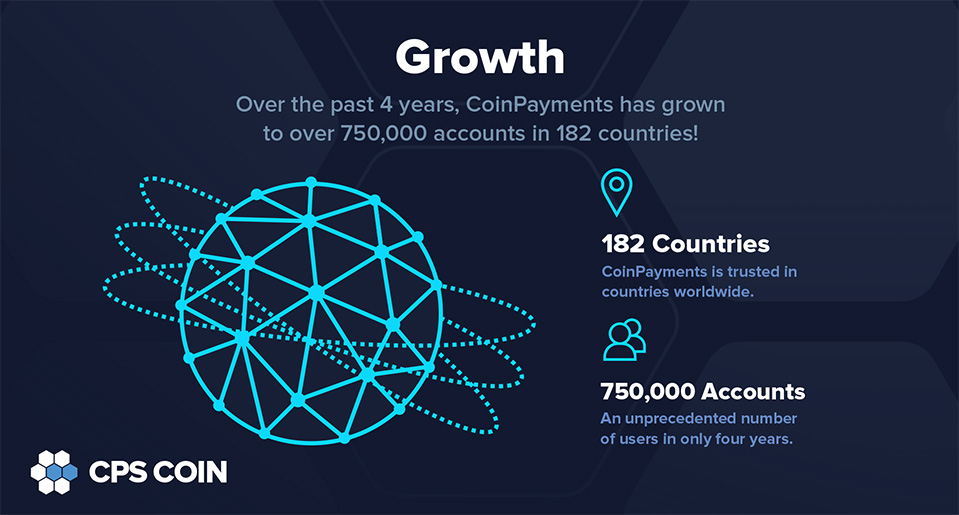
CoinPayments provides vendors with easy to use plugins, APIs and point of sale interfaces for any merchants looking to accept cryptocurrency payments. As their userbase grew, CoinPayments added many new features to their platform, including digital currency conversions, fiat settlement options and full-service packages for companies looking to launch their ICO. Over the past 4 years, CoinPayments has grown to over 750,000 accounts in 182 countries!


https://www.coinpayments.net/index.php?ref=11a72be10f06ec10ba025196f46809d1

CPS Live Ltd, in partnership with CoinPayments and Syscoin, is taking the enormous success achieved in payment processing and blockchain technology and applying it to a new venture: CPS Coin. The CPS coin will be the first digital asset built on the Syscoin platform and will bring numerous benefits and rewards to CoinPayments users and merchants, and will also coincide with the launch of a decentralized marketplace allowing users to transact with each other directly, without the middle man.

First Syscoin Asset

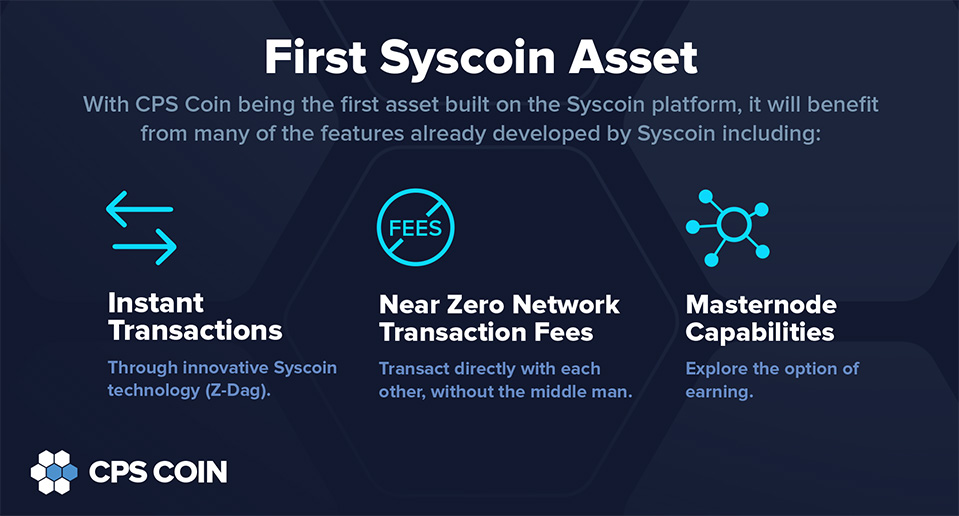
With CPS Coin being the first asset built on the Syscoin platform, it will benefit from many of the features already developed by Syscoin including instant transactions, near zero network transaction fees and masternode capabilities.

CPS Coin

The launch of CPS Coin will bring many exclusive benefits to CoinPayments accounts including:
  • Instant Transactions: Transacting with CPS Coin will offer instant transaction confirmations through innovative Syscoin technology (Z-Dag)
  • Discounted CoinPayments Fees: 50% off merchant processing fees and 50% off conversion fees when exchanging between CPS Coin and other supported currencies
  • Rewards Program: Earn monthly rewards by staking your CPS Coins
  • ICO Hosting Benefits: Stake your CPS Coin during your ICO escrow period to earn rewards
  • Coin Hosting Discount: 50% discount on CoinPayments coin hosting and renewal fees when paying with CPS Coin
  •  

Decentralized Marketplace

https://www.coinpayments.net/index.php?ref=11a72be10f06ec10ba025196f46809d1

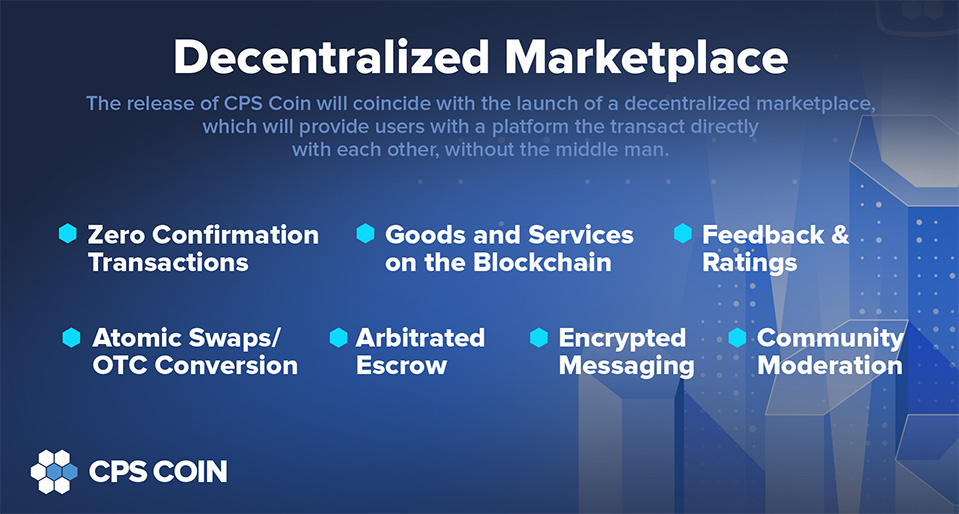
The release of CPS Coin will coincide with the launch of a decentralized marketplace, which will provide users with a platform the transact directly with each other, without the middle man. The CoinPayments community of merchants and users will jump start the usage of the decentralized marketplace from day one. Some of the many features that will be built into the decentralized marketplace will include:

  • Zero Confirmation Transactions: Instant confirmations when transacting with CPS Coin, ideal for point of sale purchases
  • Goods and Services on the Blockchain: Buying, selling, auctions, drop shipping and affiliate sales – all directly peer to peer and tracked on the blockchain
  • Feedback and Ratings: Give customers confidence with past customer feedback. Existing CoinPayments merchants can import their feedback
  • Atomic Swaps/OTC Conversion: Convert between currencies with ease or buy/sell currency through the OTC desk
  • Arbitrated Escrow: Inspire buyer confidence by using the arbitrated escrow service to secure funds
  • Encrypted Messaging: Send and receive encrypted messages within a simple and secure inbox
  • Community Moderation: To prevent another Silk Road, CoinPayments will moderate the marketplace in the beginning, eventually shifting to a decentralized autonomous governance model built on marketplace reputation.
  •  
Through the free airdrop programs, everyone has the opportunity to obtain Free CPS Coins by either starting a CoinPayments account, or storing Syscoin in their alias wallet. The success of CPS Coin and its innovative new approach to payments is guaranteed for 3 simple reasons:

  1. CoinPayments Team: The project will be executed by a proven team that helped build CoinPayments to the success it is today.
  2. Day One Community: Combining the free airdrops to Syscoin, Changelly and CoinPayments users creates a huge community of over 4 million people using CPS Coin from day one.
  3. CPS Coin Advisors: The team of all-star advisors for CPS Coin include many CEOs and founders from all aspects of the crypto industry.

To get some CPS Coin for yourself, all you need to do is have a CoinPayments account or a Syscoin alias.
For more information visit www.CoinPaymentsCoin.com.

GET YOUR FREE CPS COIN 150 CPS, JOIN UNDER.

https://www.coinpayments.net/index.php?ref=11a72be10f06ec10ba025196f46809d1

Ripple Powered Mobile App to Provide On-Demand Domestic Payments in Japan


The Japan Bank Consortium will release a groundbreaking smartphone application called “MoneyTap”— powered by Ripple’s blockchain technology — to allow customers of the bank consortium to settle transactions instantly, 24 hours a day, seven days a week.
“MoneyTap” is the first mobile app of its kind to be developed and used by multiple, different banks in the country.

Three members of the Japan bank consortium: SBI Net Sumishin Bank, Suruga Bank and Resona Bank will be the first to go live on the mobile app in autumn of 2018. This will be followed by a staggered roll out to the rest of consortium.

The Japan bank consortium, led by SBI Ripple Asia, is comprised of 61 banks covering more than 80% of all banking assets in Japan. MoneyTap will have the potential to provide on-demand payments to the vast majority of the country through this consortium.
Flexibility with domestic payments is limited in Japan: transactions must occur on weekdays and between 8:30 am and 3:30 pm or risk delays.
While there are discussions to change the window on the current banking rail system to make it accessible 24 hours a day and seven days a week, the cost of implementing it would be high.


Blockchain powered domestic payments will speed transactions and lower costs
“MoneyTap” allows the bank consortium customers to make instant domestic payments and only requires a bank account, phone number, or QR code.
What’s more, MoneyTap helps shed the costs associated with existing banking and ATM fees that are currently applied to domestic money transfers in Japan, making those payments not just faster, but cost less overall.

“We are proud to leverage Ripple’s blockchain technology through our new mobile app, MoneyTap, to improve the payments infrastructure in Japan,” said Takashi Okita, CEO of SBI Ripple Asia.
“Together with the trust, reliability and reach of the bank consortium, we can remove friction from payments and create a faster, safer, and more efficient domestic payments experience for our customers.”

Ripple wants to revolutionize domestic and cross-border payments
Ripple has long focused on providing solutions to the problems associated with cross-border payments. Currently, over 100 financial institutions use xCurrent and Ripple has made recent new additions to pilots of xRapid that incorporates XRP into on-demand international payment flows.
However, the power of blockchain can be applied to solving domestic payment issues as well.

“The release of the MoneyTap mobile app shows Ripple’s continued commitment to provide its partners across Asia and the world with blockchain-powered solutions that dramatically improve the customer payments journey,” said Emi Yoshikawa, director of joint venture partnerships at Ripple.
“We’re proud to provide this production-ready technology that not only improves the international payments experience, but also have applications for domestic payments infrastructure.”

Removing friction from both domestic and international payments is central to Ripple’s mission of establishing an Internet of Value, where money can move like information — instantly.

RippleNet Strengthens Emerging Markets Access into India, Brazil and China


According to the World Bank, global remittance payments are on track to grow by 3.4 percent or roughly $466 billion in 2018, with India and China having the highest incoming flows in 2017.
Together with this massive flow of capital, emerging markets are home to 85 percent of the global population and account for almost 60 percent of global GDP.

With a growing global need not just for access, but more efficient, transparent and cost-effective payments into and out of emerging markets — new financial institutions have joined RippleNet: two banks and three payment providers — that will expand reach in India, Brazil and China.
Itaú Unibanco, Brazil’s largest private sector bank and Latin America’s biggest bank by market capitalization; IndusInd, a leading private sector bank in India; and InstaReM, a major remittance provider based in Singapore, will use xCurrent to provide faster, more transparent cross-border payments to other financial institutions around the world.

Two fast-growing global remittance providers, Beetech in Brazil and Zip Remit in Canada, will both use xVia to open payment corridors for their customers around the world. Additionally, both will look to establish a connection for their customers into China, an opportunity that is now possible thanks to the recent addition of LianLian International to RippleNet earlier this month.

RippleNet members have increased access to Southeast Asia
With over 500,000 transactions per year from Australia, Canada, Hong Kong, Singapore and India, InstaRem will use RippleNet to connect their customers to over 60 countries worldwide.
Prajit Nanu, co-founder and CEO of InstaReM, is excited to see the company join RippleNet and to serve as an additional bridge into broader Southeast Asia for other RippleNet members.

“We are pleased to partner with Ripple,” said Nanu. “Now, RippleNet members will be able to process a large number of payouts in Southeast Asian countries through InstaReM’s secure rails.”
InstaRem is able to send funds to over 3 billion people around the world and has a growing customer base of over 40,000 businesses and individuals who rely on their services. By joining RippleNet, InstaRem will be able to provide a faster, cheaper and more transparent payments experience to every one of their customers.

RippleNet makes payments cheaper for customers in emerging markets
For financial institutions that want to provide a better payments service into and out of emerging markets, adopting Ripple’s leading blockchain solution for cross-border payments is the obvious answer.

RippleNet’s end-to-end communication and ability to settle transactions instantly means that members can save their customers both time and money, something incredibly important in developing countries where financial flexibility is often limited.
Patrick Griffin, Ripple’s head of business development, believes that providing faster cross-border transactions at a lower cost is especially crucial for customers in emerging markets.
“The payments problem is a global problem, but its negative impact disproportionally affects emerging markets,” said Griffin.

“Whether it’s a teacher in the U.S. sending money home to his family in Brazil, or a small business owner in India trying to move money to open up a second store in another country, it’s imperative that we connect the world’s financial institutions into a payments system that works for their customers, not against them.”

RippleNet’s continued expansion ultimately makes cross-border payments easier and less expensive, bringing the world closer to an Internet of Value, where money can move like information.

Ripple and Saudi Arabian Monetary Authority (SAMA) Offer Pilot Program for Saudi Banks


The Saudi Arabian Monetary Authority (SAMA) — the central bank for the Kingdom of Saudi Arabia (KSA) — has signed an agreement with Ripple to help banks in the KSA improve their payments infrastructure using xCurrent.

This ground-breaking pilot program is the first of its kind to be launched by a central bank. Participating banks from the KSA will use xCurrent to instantly settle payments sent into and out of the country, with greater transparency and lower costs.

SAMA’s support of KSA banks using blockchain technology has the potential to radically shift how banks in the country send money globally. The KSA now has access to every financial institution (banks and payment providers) on RippleNet, which will not only help modernize their payments systems, but also further their reach into major corridors.

Additionally, KSA banks’ customers will experience faster, cheaper and more transparent cross-border transactions. SAMA will also provide interested Saudi banks with program management and training.

xCurrent pilot program helps fuel global momentum for blockchain
SAMA is the second central bank to support the use blockchain technology to revolutionize payments, following the Bank of England’s successful proof of concept with Ripple in 2017.
Over 100 financial institutions already rely on Ripple to power end-to-end tracking and instant settlement for their payments around the world. The addition of the SAMA pilot program is part of a larger global trend favoring blockchain solutions for payments.

Dilip Rao, the global head of infrastructure innovation at Ripple, believes the agreement with SAMA is part of a wave of recognition by financial institutions of the impact blockchain solutions can have on payments.

“Central banks around the world are leaning into blockchain technology in recognition of how it can transform cross-border payments, resulting in lower barriers to trade and commerce for both corporates and consumers,” said Rao.

“SAMA is leading the charge as the first central bank to provide resources to domestic banks that want to enable instant payments using Ripple’s innovative blockchain solution.”
To learn more about xCurrent and Ripple’s other solutions to revolutionize cross-border payments visit our solutions page

Demystifying Digital Assets Part 1

While blockchain and digital assets have become increasingly popular, it’s hard for many outside the industry to see beyond the buzz. The adoption of the technology combined with the right digital asset can provide benefits that can drastically improve the way financial institutions do business.

At Ripple, our mission is to revolutionize cross-border payments using both blockchain technology and XRP — the only digital asset designed for enterprise use. Over the last five years, we’ve been on the frontlines of the adoption and application of the blockchain, so we believe it’s only right to share the insights we’ve discovered.

Working together with Oanda — a leading global provider for foreign exchange data services and payments solutions — we’ve co-authored a mini thought leadership series to sort through the excitement for blockchain and digital assets to help readers understand the technology, its benefits, challenges and applications.

This first post examines how and why blockchain technology has been adopted by financial institutions around the world. It takes a look at the use cases for digital assets and how, specifically, XRP is used by financial institutions today. It also looks at potential uses for XRP in the broader B2B space. We’re excited to share this partnership and series of posts. Please check it out here.

Banning Cryptocurrency Would be as Sensible as Banning the Internet


In the early 1990s, the rise of the internet coincided with the fall of communism and the Soviet Empire. It’s not a coincidence that as the internet grew in popularity and usefulness, democracies flourished around the world. The potential of the internet transcended borders and helped to change the world’s geopolitical structure.

However, as internet adoption proliferated, a number of negative uses cases emerged, sparking consumer protection concerns amongst regulators and governments. This isn’t much different from the early days of virtual currency when bitcoin was associated with drugs, guns and Silk Road.

In the case of the internet, officials and activists began calling for a blanket ban, not understanding the key role it would play in building a global community. Luckily, collaboration between countries and the World Wide Web Consortium (W3C) led to the creation of a global framework for electronic commerce in 1997, paving the way for internet adoption and growth.
You can read the rest of this article in The Hill.

SBI Virtual Currencies to Exclusively List XRP at Launch


Adding to the momentum behind XRP’s growing global liquidity, SBI Holdings announced that its newly released digital asset exchange — SBI Virtual Currencies — will use XRP as the only digital asset supported at launch.

SBI Holdings is the leading financial service company in Japan. Their subsidiary, SBI Securities, is Japan’s largest online securities company with more than 4 million brokerage accounts. SBI Virtual Currencies launched in beta on January 30. The exchange is designed to provide a respected and reliable exchange for both its institutional customers and individual digital asset buyers in Japan.
XRP’s strong institutional use case and scalability (1,500 transactions per second) coupled with the growing demand for XRP in Japan, made the digital asset a natural fit for the launch.
In a post last August, SBI Holdings CEO and Executive Chairman Yoshitaka Kitao, told Ripple Insights why SBI Holdings believes so strongly in XRP.

“Not only does it have a clear use case, XRP is faster, cheaper and more scalable than any other digital asset,” Mr. Kitao said. “I strongly believe it will become the global standard in digital currencies.”

SBI Virtual Currencies looks to join xRapid ecosystem
SBI Virtual Currencies (SBI VC) is looking to join the xRapid ecosystem — Ripple’s enterprise-grade solution — to help institutions source liquidity for cross-border payments between Japan and the rest of the world. Ripple will eventually integrate SBI VC’s APIs so that xRapid users — payment providers and banks who are transferring money into and out of Japan — can convert XRP to JPY and JPY to XRP instantly through SBI VC.
The high cost of liquidity inherent to cross-border payments is significantly decreased with xRapid, providing payment providers and banks with an efficient, scalable, and low-cost liquidity option — all while improving their customers’ experience.

Ripple’s senior vice president of business development, Patrick Griffin, believes that the partnership with SBI VC is another step toward reaching the company’s mission of establishing an Internet of Value, where money can move as freely as information.

“Today’s decision to make XRP the primary digital asset of SBI Virtual Currencies shows the utility, efficiency, and scalability respected financial institutions around the world see in XRP. This is a critical step forward in our mission to build XRP liquidity and build an Internet of Value,” said Griffin.

For more information about xRapid or any of Ripple’s solutions, visit Ripple’s Solutions page.

Q4 2017 XRP Markets Report


To continually improve the health of XRP markets globally, we share regular updates on the state of the market including quarterly sales, commentary on previous-quarter market developments and Ripple company-related announcements.

Quarterly Sales
In Q4 2017, market participants purchased $20.1 million directly from XRP II, LLC1 — our registered and licensed money service business (MSB). These participants tend to be institutional buyers, and their purchases typically include restrictions that mitigate the risk of market instability due to potential subsequent large sales
Additionally, the company sold $71.5 million worth of XRP programmatically as a small percentage of overall exchange volume. For Q4, these sales represented 0.075 percent (7.5 basis points) of the total $95.4 billion2 traded — a decrease from Q3 2017’s 0.20 percent (20 basis points).

Market Commentary: A Quarter for the Ages
XRP markets ended the year with a statement — one that will likely be remembered as a defining milestone in XRP’s history. Though the beginning of the quarter was relatively quiet — with prices trading in a range between $0.203 and $0.30 — XRP began rallying on December 12 and continued moving upwards throughout the month. It quickly reached and exceeded dollar parity on December 21. From there it climbed higher, briefly touching $2.19 on December 30 before retracing somewhat and finishing the quarter at $1.91. This price appreciation represents an impressive quarter-over-quarter increase of 887 percent and a year-over-year gain of 29,631 percent.

Given the price activity, in some respects, this quarter felt like Q2 2017. While XRP saw large percentage gains in the second quarter, its notional value was the more poignant story in Q4, expanding from approximately $8 billion at the end of Q3 to $191.0 billion4 on December 31, making XRP the second most valuable digital asset in the world. In short, XRP markets had a record-setting quarter.

An Eventful Quarter
Early in the quarter, market attention was focused on issues between bitcoin and bitcoin cash and the launch of Chicago Mercantile Exchange (CME) and Chicago Board Options Exchange (CBOE) bitcoin futures. The anticipation for futures was particularly distracting, as markets awaited a pivotal development in the history of the digital asset space. Since XRP has historically been relatively uncorrelated to BTC or any other digital asset, it was not entirely surprising that while the rest of the space found its footing earlier in the quarter, XRP consolidated instead.

In late Q4, XRP markets began to connect the dots once again. Of particular importance were the American Express/Santander partnership announcement, the activation of escrow and the connection of Korean banks to the Japan Bank Consortium. The completion of escrow represented the company’s consistent ability to follow through on a previously announced initiative. Additionally, while neither the AMEX news nor the Korean bank initiative involved XRP, these key developments prove that Ripple is gaining customer momentum. Though it’s early, and today most RippleNet members are adopting xCurrent, each one of these client milestones increases the probability that institutions will eventually use XRP and xRapid to take advantage of more efficient liquidity, just like Cuallix does today. As digital asset markets grow and evolve, newer market participants will continue to look to milestones such as these to gauge XRP’s potential.

Lastly, the fourth quarter was also fascinating with respect to other digital assets. There were some great advancements in the space. Unfortunately, there were also some concerning developments, in particular, the very public bitcoin vs. bitcoin cash civil war and concerns around ether (ETH) and litecoin (LTC) leadership commitment. This may be where XRP most significantly distinguishes itself going forward.

As established corporations consider leveraging distributed ledgers and blockchains, especially public incarnations of those technologies, dispute resolution and commitment will be key. Building pivotal infrastructure on top of technology that does not have clear governance is not palatable for large established companies. Also, from conversations with market participants as well as with possible clients, it’s clear Ripple’s consistent and steadfast support of XRP is a major advantage as the payments industry continues to seriously consider it as an alternative liquidity solution.

Dramatic Volume Increases
Of all the developments in Q4, the dramatic increase in volume likely had the most impact on XRP’s likelihood of becoming an international standard for digital-value transfer. In order for XRP to be highly efficient as a settlement asset for cross-currency transactions, it will continue to need greater volume and depth of order books. These market attributes increase its ability to support much larger cross-border payments and thus increase its utility broadly. Overall, Q4 volumes averaged more than $807.6 million per day, a 35,341 percent increase over Q4 2016’s volumes of $2.28 million per day, with much of the volume growth coming late in the last month of the quarter.

Since December 11, XRP’s volumes averaged $2.77 billion per day as the price rally progressed in earnest. Of particular importance is the growth of strategically important XRP/MXN volumes in Mexico, one leg of the first xRapid corridors. In December, XRP/MXN activity increased by more than 25x its volumes in September, and at times outpaced BTC/MXN volumes. We believe this rise in volumes is partly due to additional market maker activity at Bitso, as well as the rise in speculative interest.

Lastly, XRP also became available across more than 50 exchanges globally — which was likely a driver of growth as well. This increased global reach is the result of Ripple’s continued investment in the XRP ecosystem and will more easily allow financial institutions to source liquidity for international payments through XRP going forward.
 
Korea’s Impact Continues
Though Korean markets continued to be a significant driver of XRP activity during the quarter, growing geographic diversification of XRP liquidity lowered KRW market share to 44.8 percent of total Q4 volume.


Interestingly, this retracement of market share didn’t apply to KRW prices. As XRP advanced in Q4, so did Korea’s premium over USD markets. At times, prices were as much as 40 percent higher in Korea than the rest of the world. While it’s still somewhat early to tell, it will be interesting to see if these premiums develop into a leading or lagging indicator of market activity going forward.
Towards the end of December, rumors of a Korean government clamp down on the space began circulating. On December 27, the official news broke. However, much to the market’s surprise, the impact was muted. In fact, many markets — XRP included — continued to rally. However, what seemed like insatiable demand may have some challenges ahead. Given South Korea’s outsized volume share on digital asset exchanges, a more restrictive stance there poses a significant market risk.

What’s on the Horizon for Q1 2018
2018 is likely to be a pivotal year for the broader digital asset markets as a whole, as well as for XRP markets specifically. Q1 will be key to ensuring XRP’s liquidity eventually becomes more like that of existing foreign exchange markets and XRP achieves its goal of becoming the digital standard for international value transfer.

xRapid
On January 11, 2018, we formally announced a partnership with MoneyGram — one of the world’s largest money transfer companies — to use xRapid and XRP for near real-time cross-border payments. In addition, there are a number of other xRapid deals at various stages of completion in the pipeline. We’ll look to make those public as they’re signed and our partners agree to be publicly recognized.

Institutional Hedging and Custody
While customers can use XRP for on-demand liquidity through xRapid, we want to build the necessary markets infrastructure for eventual direct usage of XRP by financial institutions. In Q1, we’ll begin work towards the launch of institutional hedging instruments and custody solutions. Both of these market components are important to institutional adoption and thus are important components of our 2018 roadmap.
1XRP II, LLC is licensed to engage in Virtual Currency Business Activity by the New York State Department of Financial Services.
2Volume numbers reference xrpcharts.ripple.com volume data.
3Price data references on-exchange Bitstamp XRP/USD closing 24-hour bar prices.
4XRP total market cap is calculated using total distributed XRP plus total XRP held by Ripple, including XRP held in escrow, multiplied by the closing Bitstamp XRP/USD price on 12/31/2017.

American Express Joins RippleNet – Giving Visibility and Speed to Global Commercial Payments


The movement to modernize the global payment system is quickly gaining momentum as another major global financial services company joins RippleNet.
American Express is the latest company to become a member of RippleNet, joining the ranks of Credit Agricole, Airwallex, Cuallix, and more.

American Express is joining Ripple’s blockchain network to provide real-time, business-to-business global payments that will ultimately enhance their customers’ experience.
Initially, American Express FX International Payments (FXIP) will partner with Santander UK to create a transaction channel between the U.S. and U.K. — a first and a boon for the corridor. The U.S. is the U.K.’s largest trading partner, creating an immediate need for frictionless corporate global payments in the U.K. market.

Partnering to deliver faster, better service
By leveraging the power of RippleNet, FXIP customers will see an immediate improvement in how they send money globally.
Compared with the traditional payment process, Ripple’s blockchain-enabled payments simplify connections with intermediaries and provide immediate end-to-end visibility into the transaction status and cost.

What’s more, FXIP’s use of RippleNet will maintain the level of security that American Express customers have come to know and expect.
“We’ve already seen evidence that blockchain technology is playing a transformational role in the way customers are served,” said Greg Keeley, executive vice president of global corporate payments at American Express.
“Not only does this partnership with Ripple help decrease the time it takes for international transactions to be processed, it can make our transactions more effective for our customers,” Keeley added.

Joining forces to avoid settling for less
FXIP’s partnership with Santander UK to send cross-border payments between the U.S and U.K will help American Express not only streamline corporate payments, but also establish a wider footprint in the U.K.
José Luis Calderón, Santander’s global head of transaction banking, said, “This blockchain solution opens up a new channel between the U.S. and the U.K. and presents a significant opportunity for payments globally.

“Collaborating with forward-thinking businesses has enabled us to deliver this cutting-edge, secure, friction-free payment solution and extend our ‘Simple, Personal, Fair’ philosophy to American Express and their customers.”
Ripple CEO Brad Garlinghouse agreed with Calderón’s statement stating, “Ripple is taking a huge step forward with American Express and Santander in solving the problems corporate customers experience with global payments.”

“Transfers that used to take days will be completed in real time, allowing money to move as fast as businesses move today. It’s just the beginning, and we look forward to growing this partnership to help other American Express FXIP customers.
Contact us to learn more about Ripple’s growing network, and how other companies are helping to create one frictionless experience to send money globally.

Ripple Hosts World’s Central Banks to Explore Next Generation of Payments


Ripple recently gathered over two dozen central banks from around the world to explore how new technologies enable the next generation of payments.
The Central Bank Summit on Blockchain, hosted at Carnegie Hall in New York City, gathered central banks’ senior leadership, payment strategy leads and oversight staff for a focused discussion on blockchain.

Ripple CEO Brad Garlinghouse hosted the event and said, “The Summit provided an opportunity to explore the full payments landscape: central banks’ domestic trials, Ripple’s growing cross-border network and interoperability across systems. Together, these form the beginning of an Internet of Value, where payments move as easily as the data across the internet.”
Internet of Value: enabling connectivity and interoperability

The Summit started with a presentation from the International Monetary Fund (IMF) on fintech’s potential to change market structure, opening new possibilities in payments.
With this context, the Summit explored central banks’ experiments with using blockchain for domestic payments. These domestic trials explored rebuilding existing systems, building new backup systems, and creating new features such as a central bank digital currency.

The research has furthered the understanding of blockchain —  both the use cases for where it makes sense and where it doesn’t. The ultimate adoption of blockchain for domestic payments may not be universal. The optimal solution depends on the pain points and features needed in each market, which can vary greatly by country. With this realization, interoperability between systems —  both centralized and distributed  —  became a key focus area and the impetus of Ripple’s own work on Interledger.

One place where the pain points are universal is in cross-border payments. Cross-border payments — which are fragmented in nature —  are an excellent fit for blockchain technology. What’s more, the technology has been rapidly adopted in the market. Ripple shared how it has specialized blockchain for interbank payments, enabling cross-border functionality that is real-time with transparency into status and fees.
Ripple gave detailed presentations on how we use blockchain-based solutions to enable connectivity in payments. Ripple solutions connect the following:
Digital assets: The future of liquidity is here
The Summit’s presentations covered the future of seamless connectivity and interoperability, which led to the next critical component for payments: liquidity. To date, liquidity is achieved through pre-funded accounts with counterparties. Yet, that comes with costs and risks that limit reach to high-volume corridors.

The second half of the day explored the technological breakthrough of digital assets and their emerging use cases. For example, one use case that has presented great promise is using digital assets as a liquidity tool — this allows for global reach without pre-funding.
Ripple shared how the adoption of XRP to connect fiat currencies creates a new paradigm for liquidity, enabling greater reach at lower costs than previously possible. The Ripple team discussed our research on adoption models, cost savings, and key takeaways from our trials with banks.
Presentations also discussed other digital currency use cases including central banks’ experiments and the regulatory response to contain risk in ICOs.

Top takeaways for central banks
The key takeaway from the summit was that new technology is modernizing payments. There’s great potential and the Internet of Value is coming into view.
Garlinghouse concluded, “These blockchain conversations have been happening in isolation. The value of the Central Bank Summit was in exploring and connecting these efforts, as together they create the next generation of payments.”
The summit was the first of many forums that Ripple has hosted to connect banks to blockchain and digital asset luminaries, and we will continue to foster the conversation to improve the technology.